Deus Ex corridor at the Grévin Museum
In 2013, Grévin Montréal, the Paris wax museum’s new home at the Montreal Eaton Centre, had a problem: a long corridor with plain painted walls, too narrow and too short for wax figures. Instead of leaving it empty, Grévin asked a bolder question: what if visitors could step into a video game?
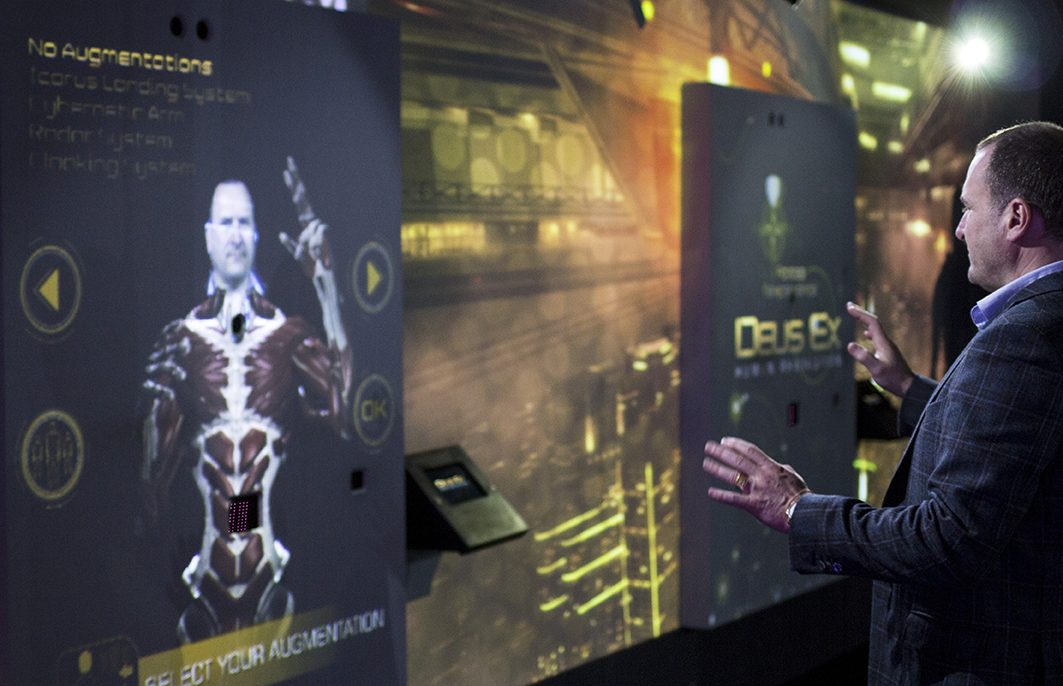
The answer was a piece of live digital theatre built around Deus Ex: Human Revolution, the hit game from Montreal’s Eidos-Montréal. Cameras, projectors and software created at Miralupa, with Geodezik and VYV, turned the bare walls into three life-size stages. A camera filmed each visitor’s face live and streamed it onto a full-size game character projected on the wall, not a photo but your actual face, moving in real time. Smile and the hero smiled. Raise an eyebrow, frown, grimace, burst out laughing, and the character did it with you, at the very same instant. Then the whole character moved exactly as you did: no controller, no glasses, no app, just your own body.
- Step onto the circle. Each station was marked by a circle on the floor. Stepping onto it woke the wall up.
- Pick your character by waving. A sweep of the hand, left, right, up or down, scrolled through the game’s cast; a simple gesture chose one.
- Become the hero, live. Your face, live and expressive, was now the hero’s face, and the character’s body became yours. Lift your arm and Adam Jensen’s blades spring out; take aim and Barrett’s arm cannon swings around with you; jump, crouch, punch, pull faces. Every move and every expression was mirrored on the wall in real time.
- Take your photo and type in mid-air. Raise a hand for a countdown, 3, 2, 1, flash, then tap your email address on a virtual keyboard floating in front of you, to receive your photo (with your consent).
More than 100,000 visitors took that photo home.
Years ahead of its time
To see how new this was in 2013:
- Kinect for Windows, Microsoft’s body-tracking camera for computers, had launched only the year before, in 2012.
- One of the best-known “live AR” stunts of the day, National Geographic’s 2011 mall screen in Budapest, placed virtual animals beside shoppers, but didn’t track their bodies or faces.
- Snapchat’s face filters didn’t arrive until 2015.
Live video of a visitor’s face, with every expression, on a life-size, full-body projected character, along with gesture menus and a floating virtual keyboard, all running reliably all day in a public museum, was years ahead of the mainstream.
What it means for your museum. Grévin had an empty corridor; it ended up with one of its most talked-about attractions, and a photo in 100,000 inboxes carrying its name. That’s what Miralupa does: we look at a space, a story or a collection, see the possibility others miss, and design the experience, using the newest technology that serves it. If you have a corridor, a gallery or a story waiting to come alive, let’s talk.
Concept: Grévin, Geodezik and Eidos-Montréal. Technology: Miralupa, Geodezik and VYV.
Watch the video >